
RF Generators Case Study
Challenge:
Modern RF generators in the semiconductor industry require power accuracy of 1% or better. To achieve this, the generators need an in-house calibration reference. Calorimeters serve as an excellent reference but are slow to calibrate, often taking over a minute per power setting. Additionally, they are expensive, making them impractical for large-scale generator manufacturing.
Directional couplers have been the industry standard for many years, but modern generators now require additional capabilities such as pulsed RF, multi-level pulsing, and tailored waveforms. They may also need to operate over wider frequency ranges or with non-sinusoidal waveforms, such as pulsed DC or custom waveform applications. These advancements necessitate new technologies, ideally offering high power ranges, fast reporting rates, and exceptional stability to enable rapid yet accurate calibration of generators across broad ranges.
Solution:
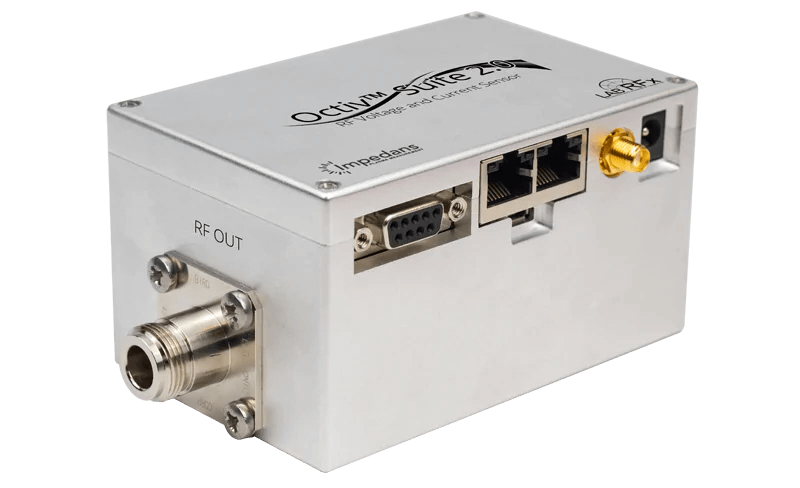
The Octiv VI probe (Mono) as a calibration standard.
Examples: The Impedans Octiv Mono VI probe has played a role as the power standard for several generator manufacturers.
Case A:
A small generator manufacturer sought a cost-effective solution to scale up production. Their existing directional coupler could only provide a data point every 2 seconds due to settling time. In contrast, the Octiv could output up to 500 times per second, and they chose to operate it at 10 times per second. This significantly increased their calibration speed, allowing them to calibrate generators 20 times faster, boosting throughput without the need for additional calibration rigs or factory space. The compact size of the Octiv and its API enabled seamless integration and automation of their production process in a very short timeframe.
Case B:
A generator manufacturer aimed to develop a generator capable of outputting directly to non-50 Ohm impedances, eliminating the variability caused by match box efficiency drift and facilitating the application of non-CW waveforms. The Octiv was verified for 1% unit-to-unit repeatability at specific non-50 Ohm impedances, with its power accuracy also confirmed under these conditions. This enabled precise power calibration for the generator, even under unusual RF conditions.
Case C:
A generator manufacturer wanted to provide multi-level pulsed RF to a semiconductor manufacturer. The Octiv’s API supports monitoring of an unlimited number of points with 1-microsecond resolution within pulsed RF waveforms. Impedans developed a simple API script for the manufacturer, enabling their existing Octiv sensors to calibrate in real-time across 6 pulsing levels. This allowed the generator manufacturer to begin the development of this new product.
Case D:
The flat panel display industry demands both high power and precision. Impedans developed the Octiv to meet these needs, offering models capable of 30 kW, 60 kW, and 90 kW outputs. The availability of these high-power Octiv units enabled a generator manufacturer to enter, and eventually dominate, the flat panel display power supply market in a segment of Asia.
